Email Us
office@francischiroclinic.com
Call Us
920.892.4833
Credit Score
- Home
- Credit Score
Dear Friends,
My 93 year old mother-in-law recently wrote a couple of checks for credit card payments that cleared, yet didn’t show on her statement, resulting in a late fee on her bill. My wife spent half a day rectifying the matter because my mother-in-law was worried about her credit score!
“I don’t want my credit score to be affected,” she proclaimed. I thought this was great. I think she is in this for the long haul – a really long haul – and I love the optimism. Not sure what she plans on financing at 93, but I would tell her to take out the longest loan period she can get.😊
In the last 10 years, she has had a broken neck, a cyst removed from her spine, a fall that broke her sacrum, and 2 compression fractures in her vertebrae. Yikes! She has endured each of these enormous health obstacles and emerged on the other side with no complaints.
When she broke her sacrum, we had to put her into Rocky Knoll for a couple months of rehab. Truthfully, there was a point where I didn’t think she would leave. Through sheer determination not to die there, she got strong enough to move back home alone.
So here is the deal. My mother-in-law is one of the sweetest people you will ever meet, and she is also tough as nails. If you could see her grit and ability to endure pain and overcome each hardship! That said, her spine is brittle – peanut brittle. Not kidding, the last compression fracture happened when she was bending forward to make her bed. I could stand her in front of you while taking an X-ray and it would not affect your X-ray density. That’s how osteoporotic she is.
So, how do you prevent and manage osteoporosis? First, let’s discuss some risk factors. Three that can’t be influenced are being a white or Asian woman who is postmenopausal. White or Asian – I frankly don’t know the “why” behind race as a risk factor, but it is one. Women – women have less testosterone than men, so start with less bone mass. Postmenopausal– as estrogen levels drop, so does bone mass. That said, osteoporosis does affect all races, man or woman.
Risk factors that you can influence: eating a refined diet that is low in not only calcium, but also other minerals that make bone like manganese, phosphorus, boron and selenium. Smoking – duh – kills arteries, and so weakens, well, everything. Drinking alcohol regularly – alcohol tends to leach nutrients. Sedentary lifestyle – use it or lose it. Prolonged steroid use – long term use of medications like cortisone and prednisone interfere with the bone-building process.
What can you do to prevent osteoporosis? First, you ideally focus on skeletal health before you are 60,70,80, or 90! The best thing you can do is bank a lot of bone mass. Which means: be highly active, especially early in life. Bone weakens with lack of use. Most people have reached their highest bone mass by around 30 years old. This doesn’t mean you stop making bone, but what happens to most of us after 30? We tend to become more sedentary.
So here is what can you do:
Get off your a@% and move.
Resistance training – that can mean light weights or even body weight exercises. Adding weights creates a healthy stress that encourages your body to lay down new bone mass.
Start early in life – pass this email on to your daughters.
Eat a whole food diet, including dairy. But make it whole fat dairy. Fat-free dairy, in my opinion, is junk food. We consume dairy for the calcium, but calcium needs Vitamin D, and Vitamin D needs FAT to be absorbed because it is a fat-soluble vitamin. So no fat = no calcium. I like to say, “Show me a fat-free udder, and I will agree to fat-free dairy!”
Eat cruciferous veggies and bone broth – these are both whole food “elixirs” that provide the remaining nutrients you need to form healthy bones.
Taking a calcium carbonate supplement – which is what most calcium supplements contain – is like eating a rock while walking through the Kettle Moraine forest. Yes, you ingested calcium, but you are also going to be pooping it out. That is why you are told to take upwards of 1000 milligrams of calcium… because you poop out 90% of it. The 10% you get in is even worse. Calcium carbonate requires about 18 enzymatic reactions to be turned into a usable form of calcium for the bone.
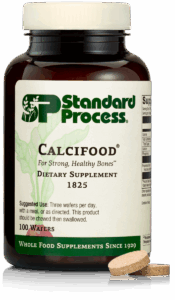
This means that calcium carbonate exhausts a ton of nutrients in your body in order to be converted to a usable form. When supplementing, we use a product called Calcifood. It is cow bone. Yup, like bone broth in a tablet. It has everything your skeletal system needs to grow stronger, because bone feeds bone.
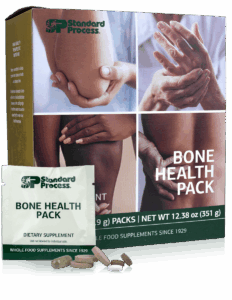
We also recommend a Bone Health Pack, which has Calcifood, Cruciferous Complete, Cataplex (Vitamin) D and Ostrophin PMG (a supplement that helps stimulate both formation).
One last note about the medications for osteoporosis. (If you have read this far, I might as well complete this discussion). In general, drugs for osteoporosis stop osteoCLASTIC activity. Put simply, an osteoclast is a cell that goes around the bone like Pac Man, gobbling up old, used, and damaged bone. The osteoBLAST then follows, laying new bone in its place. 1% of your bones are constantly remodeling.
So, bone drugs DO make your bones more dense – but they make them more dense with old, poor quality bone. That is why the recommended use for osteoporosis medications is 5 years or less, because the side effects of these drugs are – you guessed it – broken bones! So if you want denser bone tissue, you can take a drug. If you want stronger bones, you follow the advice above. As always, there are cases where someone is so brittle, or has dysfunctional osteoclasts, or another indication where medications are the best answer. Like all drugs, they have their use. But like most drugs, there is no free lunch.
Thanks for hanging in there, this was a long one – it’s probably time to get off your tush and move if you’ve read this entire letter!
Pick some healthy bone habits that you can implement today – think of it as building your bone mass credit score. It’s never too late! Your older self will thank you.
God Bless,
Dr. Dan